In conversation with Dr Ian Hendy and Eric Harris-Scott, University of Portsmouth.
May 12, 2026
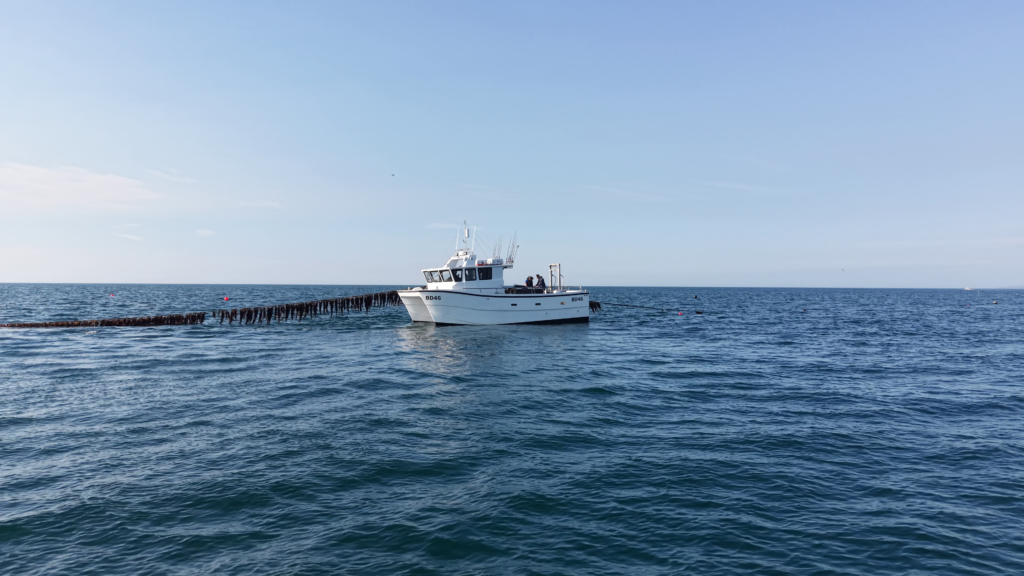
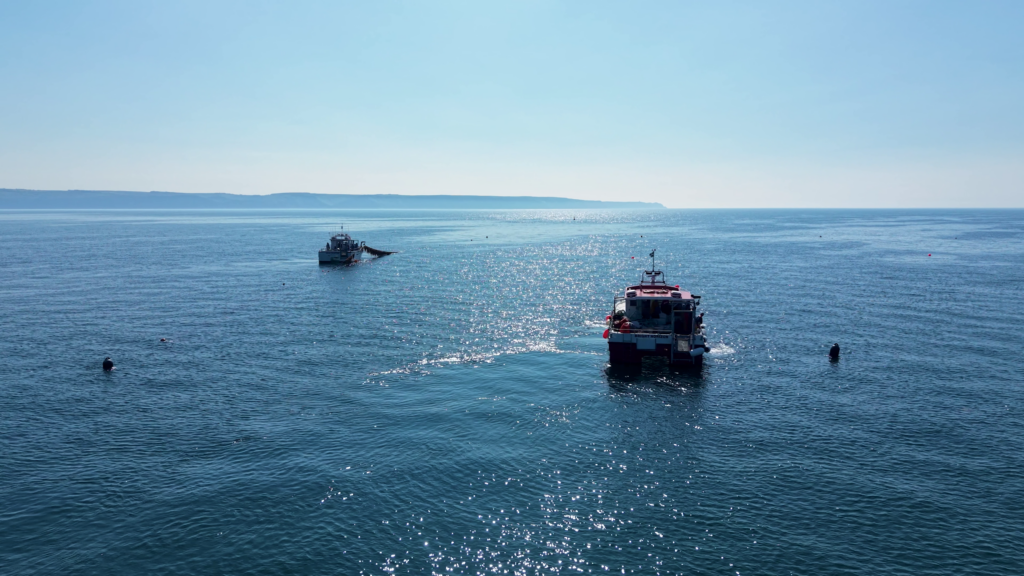
Before the Blue Forest, the seabed beneath what is now Algapelago’s 116-hectare Integrated Multi-Trophic Aquaculture (IMTA) site in the Bristol Channel was, in the words of PhD researcher Eric Harris-Scott, “a very featureless seabed – lots of coarse sand and mud, no real 3D structure.” It was a heavily trawled stretch of coastal water and now supports few resident species. Lundy Island – England’s oldest Marine Conservation Zone – sits just to the west. It is a jewel of biodiversity. The waters around it tell their own story of how much has been lost from our coastlines. Despite the different habitat types, this proximity makes the difference even more pronounced.
“There’s a real gem just next door, but I think that highlights the depleted state of our coastal ecosystems — just next door is something so well protected, you’re not seeing the same biodiversity within a short distance.”
— Eric Harris-Scott, University of Portsmouth
The Science of Structure
What transforms a marine desert into a thriving ecosystem? Structure. Dr Ian Hendy, marine coastal ecologist and Eric’s PhD supervisor, is unequivocal on this point. Where you add physical complexity – whether natural or artificial – you create the conditions that life needs to take hold.
The mechanisms are elegant. Structure creates shade, lowering water temperature and increasing oxygen availability – both vital for the rapid growth of young fish, known as juveniles. Structure also reduces flow velocity on its lee side – the area sheltered from the current. Lower velocity means fish use less energy to remain stationary. In darker water, fish benefit from countershading, an evolutionary adaptation in which dark backs and pale bellies help them blend in, making them harder for predators to spot. As Dr Hendy puts it, “anywhere where you have lots of structure, it invites lots of juvenile and prey organisms because there’s relative safety there.” The result is what ecologists call the reef effect, where greater habitat complexity leads to higher biodiversity (variety of species) and biomass (total mass of organisms).
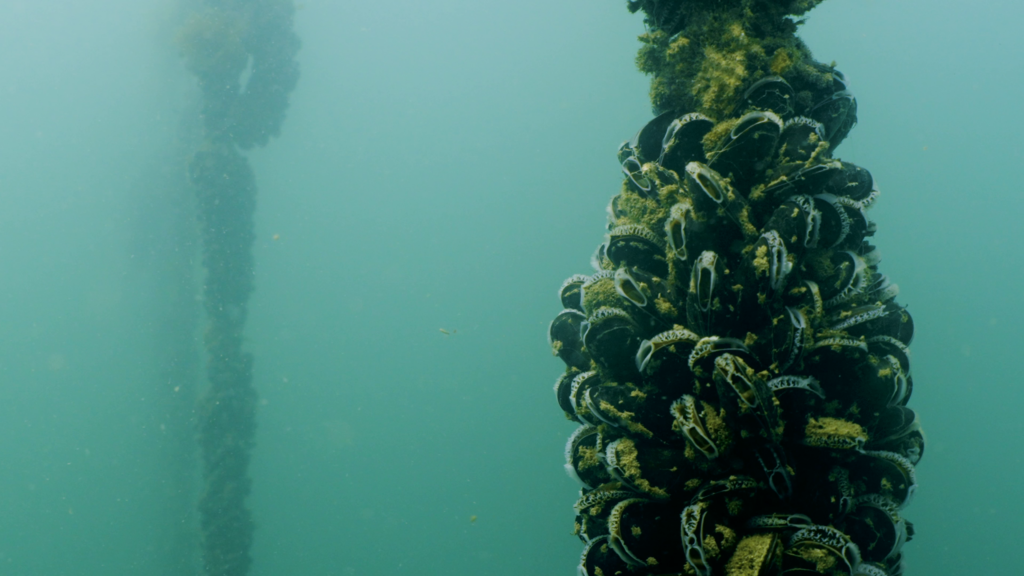
This is precisely what the Blue Forest is beginning to provide. Its kelp longlines and mussel infrastructure introduce 3D habitat into water that previously had none. Dr Hendy describes this as “a small island – a reef-like structure enhancing all of these organisms.” with the goal of creating ecosystem resilience. Critically, as an IMTA system, the farm is protected from trawling and dredging. This gives it a de facto Marine Protected Area (MPA) enhancing benthic cover and biodiversity. MPA research consistently documents what Hendy calls a ‘spillover effect’: biomass builds inside the protected zone and then spills outward to benefit surrounding fisheries. In turn, this gives the Blue Forest site the opportunity to use a new structure that develops into a haven for species, just as Lundy Island’s own Marine Protected Area does next door.
Measuring the Uplift
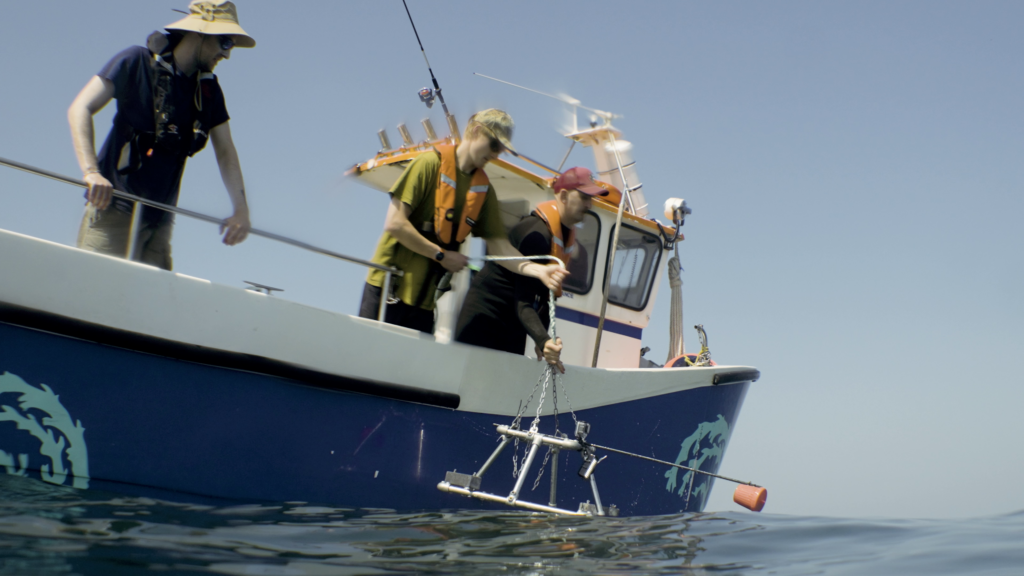
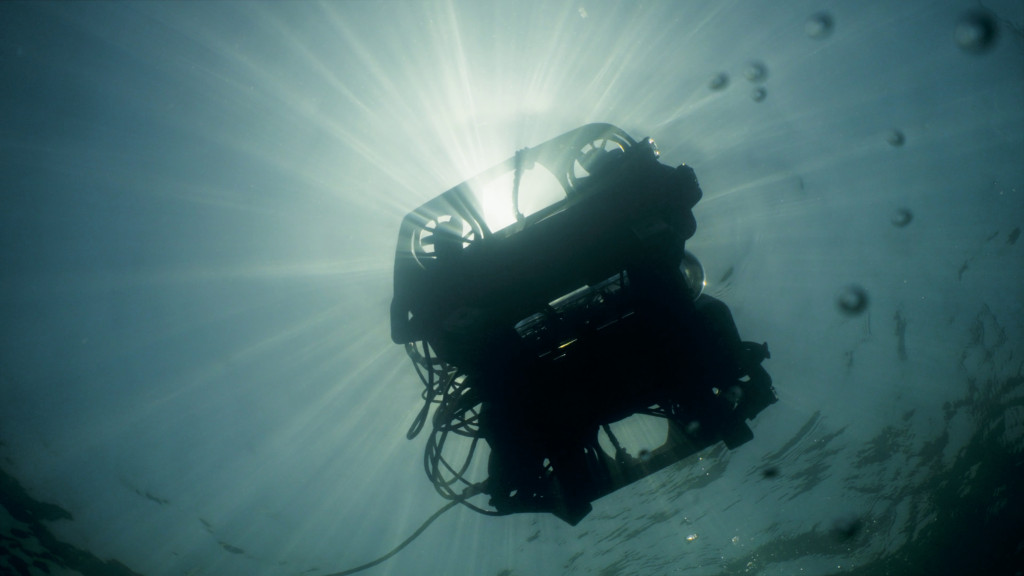
Eric Harris-Scott’s PhD is funded through a partnership between the Blue Forest, the University of Portsmouth, and Nestlé R&D. He is building the evidence base to rigorously test these assumptions. To move from anecdotes to hard data, Eric’s methodology spans multiple levels of the food web. He directly samples epifauna and epiflora (animals and algae living on the surface of kelp and mussels) to capture the base of the food chain. He uses baited and unbaited underwater video on the farm’s headline ropes to record mid-water pelagic species (free-swimming fish not near the bottom or the shore). SMURF units (Standard Monitoring Units for the Recruitment of Fish, scientific structures used to monitor young fish populations) are also deployed. These tools track fish settlement across their first summer after transforming from larval stage into juvenile fish. Eric then records not only which species are present, but also takes measurements to investigate growth rates for comparison with wild coastal kelp and mussel habitats.
The site’s location adds an important dimension. It is sandwiched between the North Devon coastline and Lundy Island and sits between two established nursery habitats for juvenile fish. The question Harris-Scott is asking: Can the Blue Forest serve as a stepping stone? Providing a refuge that connects two productive zones to increase the number of fish that reach adult size and, in turn, support the local fisheries?
A further novel line of inquiry concerns the relationship between the kelp and mussel components of the IMTA (Integrated Multi-Trophic Aquaculture) system. Kelp is ephemeral — it is harvested after six or seven months. Mussels, however, develop year-round. Harris-Scott is investigating the extent of overlap between the communities each structure supports. If a Venn diagram (a diagram that shows logical relationships between sets) of species using both infrastructure types shows significant overlap, it suggests the mussel infrastructure could sustain biodiversity through the off-season, when no kelp is present. Early ecological expectations are positive. “In coastal habitats, you get a mosaic of different habitats… I’m expecting that there is a good deal of crossover,” he notes. As a result, he expects the Blue Forest system to show high or improving ecological resilience.
More Than Monitoring: The Bigger Picture
Dr Hendy places the Blue Forest within a stark national context. The ecosystem services and associated fisheries provided by the UK’s kelp, salt marsh, seagrass and mudflats were valued at £211 billion by the Office for National Statistics in 2021. Over the past fifty to sixty years, roughly half of those habitats have been lost. “Back in the day, we could calculate the equivalent value of those was around £400 billion,” Hendy observes. The UK government’s own assessment, while alarming, strengthens the case for regenerating these dynamic, socio-economically and ecologically invaluable habitats.
There is a concept in conservation biology called the shifting baseline: the idea that each generation calibrates its sense of “normal” against the nature it first encountered, with no felt sense of what existed before. Dr Hendy gives it a vivid human face. A fisherman today thinks the sea he works in is simply the sea. His father knew richer waters, and his grandfather richer still. Peel it back far enough, and you find coastlines thick with kelp forest, shellfish reefs, salt marsh and seagrass — habitats that the ONS now values, even in their diminished present state. Unfortunately, we barely notice because the loss happens one generation at a time.
A further problem for restoration is that much of that habitat cannot simply be put back where it was. Coastal development has created what Hendy calls a phase shift — sea walls, marinas and harbours have locked the shoreline into a new, impoverished steady state from which natural recovery is effectively blocked. The Blue Forest is a response to that reality: taking the ambition of restoration offshore, into water where it is still possible to act. It is not, as Hendy frames it, an intervention so much as a restitution — not adding something new to the ocean, but returning a fraction of what has quietly been taken from it.
“We’re not adding to [what was there] — we’re just adding back what we’ve already lost.”
— Dr Ian Hendy, University of Portsmouth
The Blue Forest represents a different kind of solution to that loss. Unlike conservation or restoration projects in coastal habitats like seagrass or oyster beds which cost millions, it is a commercial operation that must be economically viable. Harris-Scott sees this as a strength rather than a compromise. Proving that marine-source products — whether food, fertiliser, or something else — can be produced sustainably and profitably creates a template for others to . Scale matters enormously. A single site, however well designed, is only a “pin drop,” Hendy notes. But a network of IMTA sites, with spillover zones—areas where environmental or economic benefits extend beyond the original site—beginning to overlap, would see benefits multiply on a near-logarithmic curve.
The research is still in its early stages. Both scientists are careful to situate what is known against what remains to be demonstrated. But what is already observable offers promise: crustaceans and small fish feeding on dropped mussels beneath the lines, gulls and diving birds congregating to feed in large numbers. Ecological succession is beginning in real time. This offers a glimpse of what an ocean, given half a chance, can do.